Universal Zero Trust Network Access
A Universal Zero Trust Network Access is a client-based ZTNA solution that
-
enables administrators to allow access to internal network resources according to user identity including user trust and posture, without granting access to the entire network as with Remote Access VPN.
-
does not assume that access granted to one application implicitly authorizes access to other applications, which reduces the network attack surface.
-
ensures least-privileged, per-application, per-user access with strong authentication, posture validation, and comprehensive traffic inspection across hybrid environments.
Components of Universal ZTNA
Universal Zero Trust Network Access (universal ZTNA) enables administrators to specifically allow access to internal network resources according to user identity including user trust and posture, without granting access to the entire network as with Remote Access VPN. Universal ZTNA is a client-based ZTNA solution that enables users to securely access internal resources and applications regardless of their location, whether remote or on-premises.
Because universal ZTNA does not assume that access granted to one application implicitly authorizes access to other applications, the network attack surface is reduced.
Universal ZTNA ensures least-privileged, per-application, per-user access with strong authentication, posture validation, and comprehensive traffic inspection. It secures applications effectively across hybrid environments.
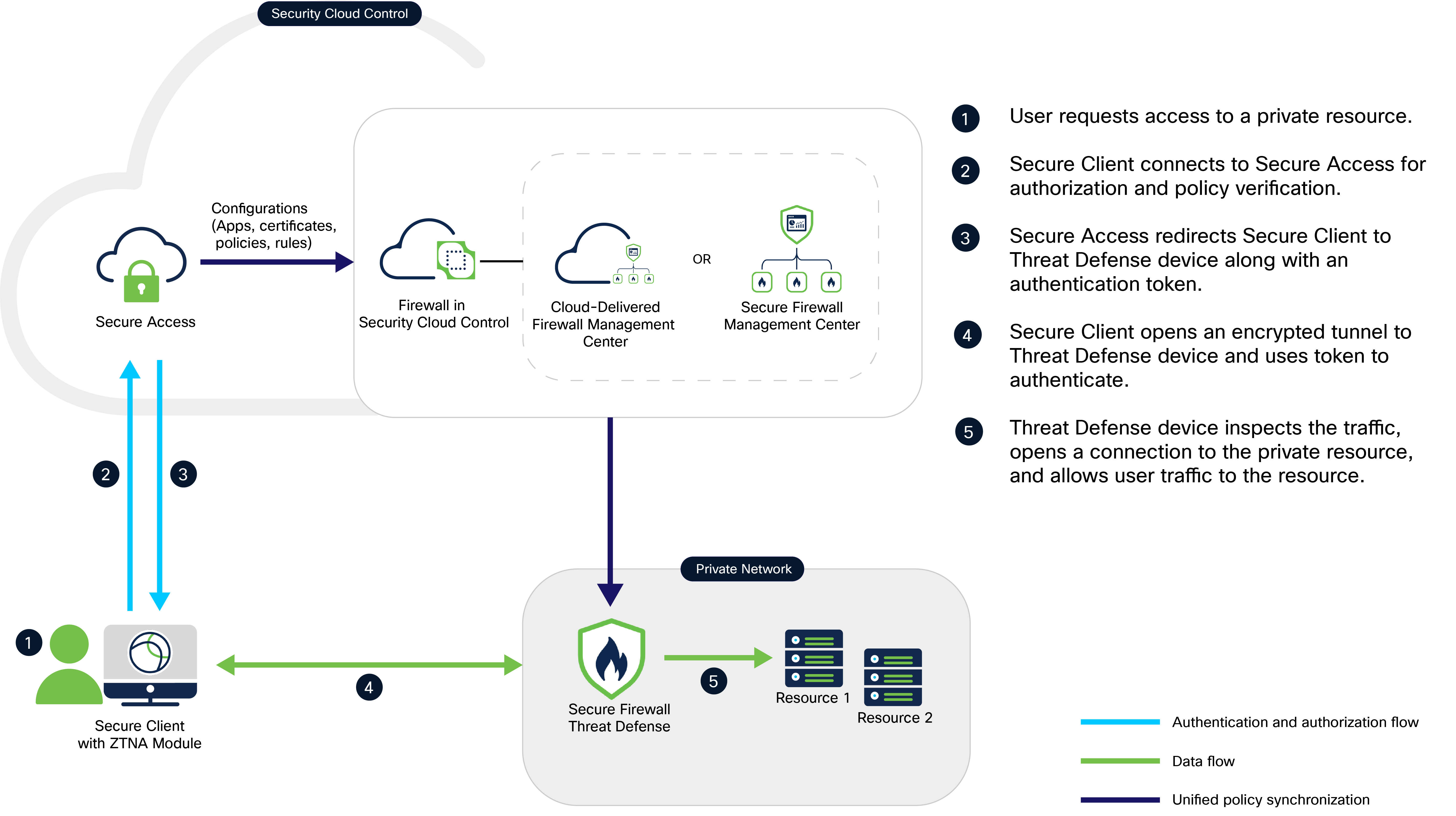
A new configuration of universal ZTNA consists of Security Cloud Control Firewall Management (formerly called Cisco Defense Orchestrator), and Secure Access, both provisioned on the Security Cloud Control platform. Security Cloud Control Firewall Management manages the Firewall Threat Defense devices through the Secure Firewall Management Center.
-
Security Cloud Control Firewall Management: Manages the configuration and deployment of universal ZTNA policies to the Firewall Threat Defense devices. The Threat Defense devices protect on-premises resources by enforcing universal ZTNA policies. Threat Defense inspects traffic and enforces intrusion prevention system (IPS), file, and malware policies on the traffic.
-
Secure Access: Secure Access defines the access policies, posture, and security profiles for the user. It enforces the policies for user traffic through the cloud.
-
Security Cloud Control platform: Security Cloud Control provides a unified secure management plane for both Secure Access and Firewall, simplifying the administration of universal ZTNA policies across them.
-
Secure Client: The Secure Client is installed on the end user's device. It acts as the enforcement point that intercepts connection requests to protected internal resources, enabling secure, identity-based access.
This topic describes how to enable universal ZTNA on a Threat Defense device. For the complete configuration of universal ZTNA, refer to the Universal Zero Trust Network Access Configuration Guide.